Featured

Katharina’s Story: Chapter 24 – The American Dream?

With the beginning of June, the time for all the good-byes from my family drew close. We were to leave on the 14th of June by train from Aschaffenburg, where Roland was stationed, so I took my leave a few days earlier in Altenstadt. Happily, there were only hugs and well wishes; with all the great expectations keeping my spirits buoyed I had no tears. I had my suitcase packed, taking only clothes and personal care items, everything else had been packed up by the Army and was presumably well under way.

That suitcase of mine remains with me to this very day, the one that carried a naïve young girl away from her family to a new life in a new land.

Arriving in Bremerhaven we checked in and were assigned a hotel room; the ship was to leave the following day. That morning we had breakfast together, Roland ordered eggs over easy and toast and, since I did not know what those kinds of eggs were, I safely ordered the same. (Poor guy – and I only always had been feeding him bread and jam for his breakfast).

Once we had been taken aboard, we were separated, he with the enlisted men, I with the “dependents.” I was paired with another girl, in a small cabin with bunk beds and a sink. Other shared facilities were down the corridor. I don’t remember much about meals, I automatically followed others with a herd instinct. I do remember the social evenings lead by a preacher. Once the men were off duty for the evening, they were allowed to join their “dependents.” We did the Hokey Pokey: “Put your left foot in, put your left foot out, put your right foot in and you shake it all about”, the bunny hop, and the chicken dance and sat together for a couple of hours. A snack of sandwiches was offered, a slice of cheese between two slices of freshly baked bread, simple but, Oh! That bread was good.

Papa had supplied me with some pills for seasickness, but luckily the seas were friendly, even though while making one’s way through the corridors one learned how to use those “sea legs” to keep one’s balance. The remainder of the ocean crossing was uneventful, though I looked forward to the bread and cheese every night.

As we approached New York Harbor, the level of excitement rose throughout the ship. We should have a chance to see the Statue of Liberty! But I must have followed the wrong herd, I was on the wrong side of the ship and did not see it.

Before being allowed to disembark we were reunited with the men again and given instructions about our lodging for the next couple of days. We were assigned a room on one of the upper floors of a nondescript hotel, its single window looking out over dirty, trash-cluttered rooftops of a waterfront neighborhood, leaving a bad first impression of New York in my mind. After we got settled, Roland took me down to the busy, noisy city streets and found a dingy-looking little hole-in-the-wall place to buy us a hamburger. I suppose that was what he was craving after the chow onboard ship. And for me it was something totally foreign; I devoured it with gusto!

The following day Roland had to go to some Army facility to get his discharge papers and I was to go to Grand Central Station to get our tickets for the train trip to San Antonio, Texas. He had left early that morning and I was taking my time trying to figure out how to best accomplish my task. I had gathered some experience in how to navigate the subway in Paris, so I was confident I’d be able to handle this as well. Once I had figured out which train to take to get to Grand Central Station, I tried to get on the proper platform. I had a good supply of coins to use at the turnstiles. There were no other people around, and try how I may, none of the coins were accepted by the contraption to let me through to the platform. I turned back and wandered around helplessly and was finally approached by a police officer. I tried to explain my predicament and he informed me that I needed tokens. To my inquiry as to where I would get those, he directed me to an office “over there.” Unfortunately, it was past the time of the morning’s rush hour traffic, and this office was closed. The policeman asked me where I was headed, and when I told him he said he’d get off duty in a little while and he would help me. Seeing no other way, I agreed, and he got me through the turnstile and onto the platform. There he offered to accompany me to the train station and then escort me back to the hotel. – Aha! Well, as much as his kindness was appreciated, he would not be compensated for it in that way. I might have been fresh off the boat but fallen off the turnip truck I had not!!

I made a mental note to myself: “Add this experience to the same category with the man who tried to pick you up at the café back in Aschaffenburg. Men are the same everywhere. Even police officers. Be watchful, Katharina, your naivete is showing.”

The passenger train to Texas took several long days and uncomfortable nights in coach, with several stops along the route; we changed trains in St. Louis with a lengthy lay-over, then took the Missouri Pacific on to our destination. I felt like asking “are we there yet?” but I knew we were not even in Texas yet, and when we did get into Texas the endless-seeming distances between cities became longer in proportion to my impatience.

When we finally arrived, Roland’s brother Gerhard picked us up at the station. Getting off the train felt like stepping into a sauna. In no time I felt sweat trickling down the back of my knees and my armpits became saturated. I wondered how I would ever get used to this uncomfortable climate.

Roland’s parents were expecting us. They owned a small house on the Southside of San Antonio, on Kelly Drive, with two bedrooms, a living room, kitchen and one bath. My mother-in-law Maria gave us her room, and Anton, my father-in-law, slept on the screen porch. Roland’s little brother Siegfried, who was by then seven years of age, and his mother Maria used the room the males usually shared.

It would take a couple of weeks before my stuff would arrive, and we could begin to live independently. Our independent beginnings were primitive. We rented a small furnished backyard apartment next door to where Roland’s parents lived. It consisted of one room, a kitchen, and a bathroom. The shower stall in the bathroom was mildewy, but there was running hot and cold water and a flush toilet, all luxuries compared to my home in Altenstadt, so I really didn’t mind having to brush my teeth at the kitchen sink. The one room had to serve as living room and bedroom, the only furniture was a full-size bed with a mattress with a depression that left you on springs. That was the side I slept on, I put a pillow in the hole and did not complain, nor did I complain about the scorpions that came crawling up through the spaces between the floorboards.

Over the years we graduated from that shack to a duplex apartment and by 1957 we bought a 3‑bedroom house in a new development for $10,300. Little by little I had become more familiar with the American ways, even though we still spoke German at home. I learned to put curlers in my hair, to shave my armpits and legs; to shop at supermarkets where the meat came prepackaged, and the bread was baked in factories. I had to learn to think in inches, feet, and yards, and in solid and liquid ounces. How complicated this system was compared with the metric system in Germany and much of Europe! I transformed myself into a proper American housewife.

I earned my American citizenship in 1959. Now we were reasonably settled, with a fairly secure income and a steady daily routine. I had two young children and struggled at times with the daunting task of being a young mother without a useful support system. Yet, with no financial hardship, routine and a comfortable life brought with it a feeling of complacency.

Roland was working full time and had joined the Army Reserve. He was ambitious to become an officer and took a Reserve Officer’s correspondence course. He was very proud to graduate as Second Lieutenant. However, he spent little time at home, favoring his professional relationships and those with his parents and siblings. They spent time comparing notes on how their lives developed in this new country, while I had my own, lonely list of daily duties that sustained Roland’s presentation as a man of family, a man of integrity.

The stark realization came to me that we had no common interests. In truth, we were living separate lives. He was focused on his success and climbing the social ladder, while I was home alone — a mere housewife — feeling as unimportant as any piece of furniture. I was despondent and felt that Roland was ignoring me and his children – his own nuclear family, in favor of proving his worth to the outside world. This marriage, that began with such high hopes and exciting intentions, slowly died from neglect and a failure to be able to communicate constructively.
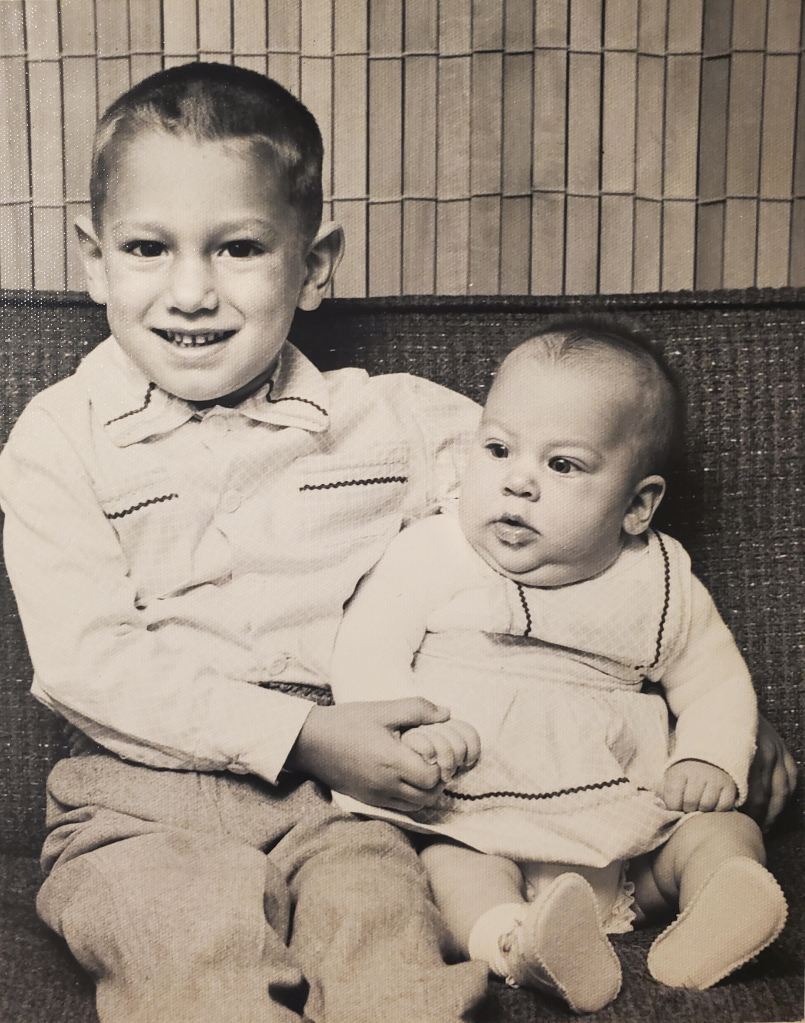
Her two young children, 1959. Katharina sewed her children’s clothing.

Thinking back about all this I have concluded that I was lacking principles. I had no principles of how much I could accept and tolerate. Naively I thought my tolerance and patience would be endless. I did not set any limits, no boundaries. I was a follower and an enabler and have myself to blame for not speaking up. This is not a course I would advise for any young woman setting out on her path in life, wherever it may lead her.

Certainly, things might not have been so damaging if I had spoken up, instead of keeping it inside where it festered, if I had let my husband know what hurt or offended me instead of tolerating it quietly. It has occurred to me that certain “wisdoms” adults implant into a young mind can be very detrimental to a developing character. As much as I loved my Omi Marie Eberhardt, she taught me early that “speaking is silver, but being quiet is gold.” I think I kind of lived by that. I kept quiet when I should have talked.

Many times, my Mutti had told me I take after her mother-in-law, my Oma Hedwig Podack. Those two women just never got along, so maybe that’s why I always felt my own mother didn’t like me all that much. Yet we felt closest while we sewed and prepared my wardrobe for travel; and if you recall, my Mutti Nora and Oma Hedwig seemed to have been closest when Mutti sewed for her mother-in-law. And as I missed my family, living in America and cut off from them, albeit by my own choice, I came to realize how much in me was part of my Oma — the melancholy that was said to be a trait of East Prussians, the resignation into one’s fate, if by one’s own choice or caused by circumstances – and a deep pain came to live inside me.

I wondered then as I do now, how my life would have turned out differently had it not been for the war. How it would have been to grow up in Kalthof on Gärtnerei Podack, where my character had best been molded.

I think the hard years after the war in Altenstadt, my having to care for the two little siblings during the Waschküche time, being responsible for them at age 10, and the following years watching the struggle of my parents in building a livelihood made me grow up faster in many ways, feeling ready at an earlier age to take on life‘s difficulties. I am not saying that I was mature enough to do it, but I felt that I was ready to fly the crowded coop with sufficient life skills.

Surely my immaturity was in the field of human relationships, in the inability to express and assert myself, in not setting some moral code for myself. I was self-aware enough to know that my moral values had suffered a lot due to the events of war, and what I learned afterwards of the unbelievable atrocities that had been committed. What came to live inside me was the notion that life did not seem to have much value, so why not follow your feelings unrestrained? Making firm plans for one’s life was useless. Things will happen that are out of your control anyway.

Maybe it was this feeling of helplessness, akin to desperation, that drove me to the decisions I made about leaving everything familiar behind and jumping into the unknown. Because, really, that‘s what it amounted to. 

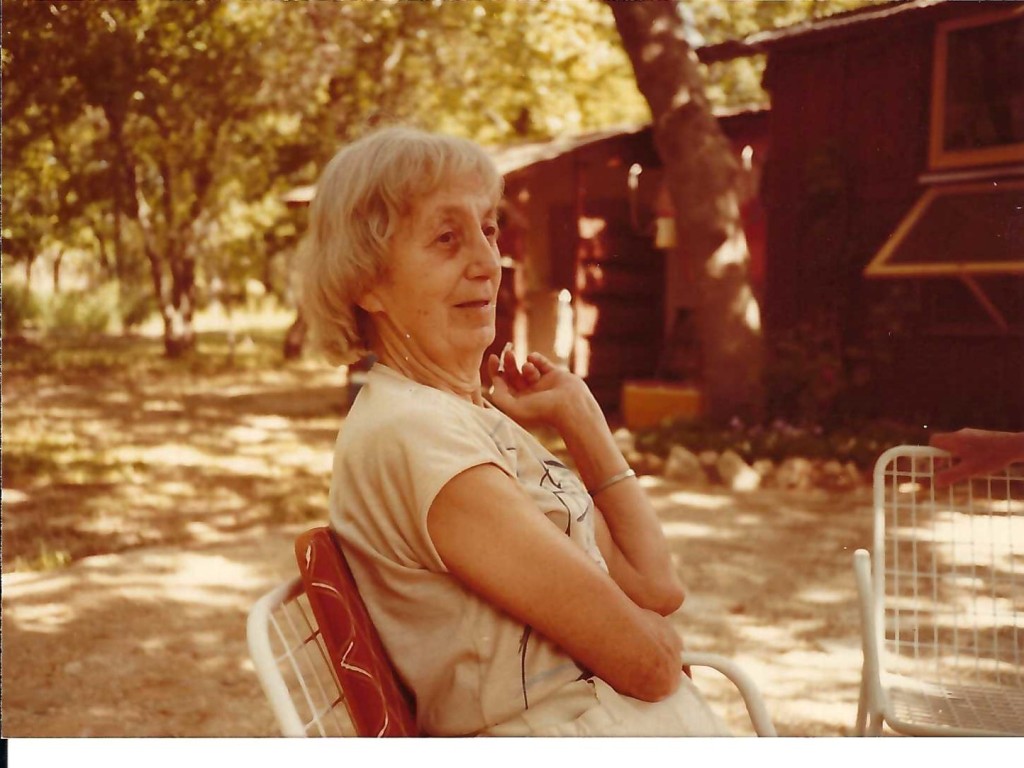
Now I am 88 years old and look back on 68 “adventurous” years lived in the United States, sharing this part of my early story with those who may find some value in it. Who are you?

  • Perhaps you are a person of a certain age, who can relate to my circumstances.
  • Perhaps you are a young woman who has a curiosity about those who came before you.
  • Perhaps you are girl with not much else to do but scroll through internet blogs.
  • And perhaps you are someone who feels he or she has realized their own independence, making decisions on their own; of their own free will.

But the questions for each are these:

  • Have you secured herself in your own agency?
  • Are you actively taking control of your life by cutting through all the noise, finding emotional and physical balance, thinking more clearly, and advocating for yourself?
  • Are you quite sure you are not a passive character in the story of your own life?

I’d love to know.
Feel free to leave your comments; I have shared my story – now you can share some of yours.

Live a daring life, wisely.

Katharina
Katharina’s Story – Chapter 23: Katharina Gets Married

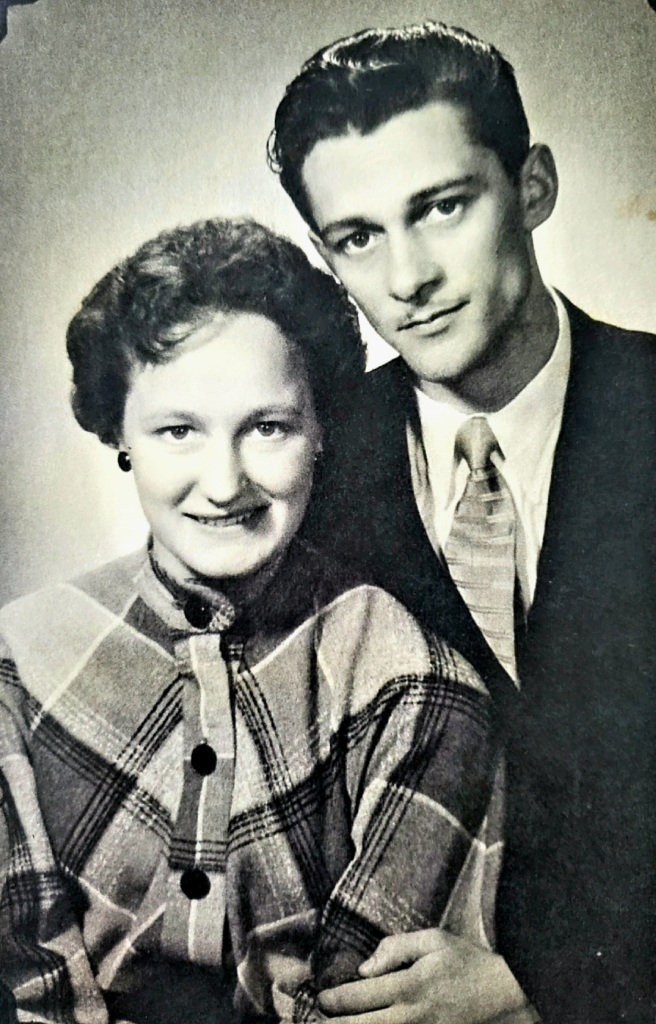
When Roland’s family emigrated to the United States it had seemed improbable, if not impossible to me, that he would ever come back for me. But here he was, and I was still in school with a year to go to graduation in the spring of 1955.

After he had shown up so surprisingly at our door that balmy winter day last year things developed rather quickly. There was tremendous chemistry between Roland and me, and I was easily led, eager to please him. I truly believed to be in love, or what I thought love was. The way plans between Roland and me had ripened it seemed a foregone conclusion that we would marry.

Truly I was too immature to get married. It was an easy way out of my parents’ house, something I desperately wanted. Besides, I had no idea of what to do with myself after graduation. Roland wanted me and the adventure of “going to America” was irresistible.  

It became clear to my parents that I was determined to go back with him to America at the end of his tour of duty in Germany if it could at all be made possible. This decision on my part was in fact the reason why the trip to Italy had been advanced for the summer of 1954, for my benefit — since I would likely not be here anymore the following summer — after graduation.

I do not remember that Roland proposed, which you would think is an occasion that would remain in my mind. I am not certain he ever asked my parents for their consent, which was legally required, since at age 20 I would not be of legal age until the end of 1955 when I would turn 21. They could easily have withheld their permission and thereby made it impossible for me to leave with him. It must have been a difficult decision for my parents to go along with my wishes, as they did not approve of Roland for me.

Understandably I had lost all interest and ambition at school. I worked just hard enough to make sure I would graduate. My thoughts were always elsewhere, dreaming of the greatest adventure of my young life. I began to imitate the American women I saw in magazines, always with perfect make-up and coiffed hair, beautiful clothes. I started smoking on the sly — Roland supplied the cigarettes. One time at school while I was supposed to be guarding our classroom during recess, I lit up a cigarette, sitting on the broad red sandstone sill of an open window, blowing the smoke outside. Unfortunately, one of the teachers was passing on the sidewalk below and noticed the smoke billowing out into the blue sky. I was in trouble. My parents were notified, and I might have been expelled had it not been so close to graduation.

I practiced applying lipstick, spending time looking at myself in the mirror, wanting to become more American-looking. My little 11-year-old brother Rudi hated what I was doing and showed his disgust by throwing my lipstick over the wall which bordered the back of our garden. I could have strangled him.

We got married March 9, 1955, in a civil ceremony at the Justice of the Peace in Büdingen, several weeks before I graduated in April, so as it was, I finished school as a married woman. When the Dean handed out the diplomas, he called Hardy and me up at the same time, calling for “Hardy Podack und Katharina,” without using my married name, because there was no such name on the school records.

My parents gave a dinner reception and dance in a hall in Büdingen. Roland’s sister Gertrude, who had not emigrated to America, was married, and living nearby in Düdelsheim.  She was there – the only one from his side of the family – both my grandparents were there, and all my classmates had been invited.

I was now the wife of an American citizen, so with the marriage license in hand Roland started the process of getting his wife to America with him when his tour of duty came to an end. I’m not sure of what restrictions might have been in place at the time for American enlisted men to return home with their foreign wives, as America’s War Brides Act had expired in 1948. The red tape started; I had no copy of my birth certificate; it had been destroyed during the bombing and siege of Königsberg.

I was required to obtain several affidavits from relatives to verify my place and date of birth, but on all official documents it still only stated: documentation not available. My Papa underwent a background check and was cleared. There were questionnaires to be filled out. All this and more to get a visa. I had to go to some part of the American Embassy in Frankfurt to get a physical. I stood in line with several other women, bared to the waist, waiting for my turn to be examined and receive the necessary vaccinations. We moved along like on a conveyer belt. No privacy here!

After having been approved and found acceptable by the authorities, preparations began at home. Mutti wanted to sew an entire wardrobe for me, mostly summer things for the Texas climate. We browsed through patterns and went shopping for materials and we sewed and fitted and talked and decided, and to me this was a time when Mutti and I were closest. Who can think about school with all this going on?! But I kept going back to school as usual, prepared for all the final written exams and hoped I would not get any oral tests in front of the whole Collegium. I was not that lucky. I was questioned in Chemistry and the question was: “Tell me about the chemical process that takes place when you put your clothes into your new washing machine in America.” I drew a blank and got a “D” in Chemistry. What did I know about washing machines? We did our laundry by hand, boiled things in the big kettle in the cellar in Altenstadt.

High School Graduation, Büdingen – 1955. Wolfgang Ernst Gymnasium.
Katharina (20 years old) is in the front row, second from right. Hardy is in the second row, first on left.

I was to have a dowry, 2,000 Marks in cash (exchange rate at that time four Marks to one dollar, that made it $500) and an equal amount in household goods, which the Army would pack and ship. Mutti and I went shopping in Frankfurt. I picked out a pattern for a silver plate cutlery set: a set of dinner knives, forks, soup spoons, breakfast knives and forks, teaspoons and dessert forks, service for eight. China: a breakfast set of plates cups and saucers, a serving plate in the same pattern, service for four; a dinner set of plates, soup bowls, cups and saucers, coffeepot and teapot, sugar and jam bowls, a cream pitcher, serving bowls, platters and a soup tureen, wine glasses, service for eight, one frying pan, a meat cleaver. And Mutti insisted on getting me a tiny set of espresso dishes with matching tiny spoons and plates for petit fours, table linens and vases. All society stuff, nothing like we were used to in this primitive old house.

I think Mutti bought me all the things she would have liked to have if she had had a proper place to entertain. I went along obediently; I had no idea what it takes to outfit a household. We bought down filled comforters, pillows, sheets and duvets, wool blankets. Papa ordered some crates built which turned out to be unnecessary. The American movers had their own boxes. They came one day and packed everything up and hauled it off to be shipped to Kelly Drive in San Antonio, Texas, where Roland’s parents lived.

Meanwhile Roland had rented a room for us off Base in Aschaffenburg. A divorced man had lived in this house with his mother and after her death, he rented her old room to us. For the remaining weeks before our ocean voyage, we lived there. We both slept in the single bed; I kept bread, butter and jam on a shelf in the old-fashioned wardrobe to have for breakfast before Roland left at 6 am for the Army Base, then I crawled back in bed and caught up on sleep which always eluded me in the cramped closeness of the old bedstead. It seemed Roland had no trouble getting his ZZs.

During the day I had the use of the rest of the main floor of the house and of the kitchen. Our landlord used the rooms upstairs and we seldom saw him.

Most grocery purchases I did at the local stores which were familiar to me, but I was soon introduced to the military’s PX and the Commissary. What a labyrinth that turned out to be. I had gotten cigarettes from the PX and wanted to buy coffee at the Commissary for Mutti. I walked the aisles for miles before I finally found it. The way I was used to shopping was – I went into the store and asked at the counter what I wanted, and it was set onto the counter in front of me. So easy!

The days grew long for me; I did some reading, washed my things in the bathtub and hung them to dry wherever I found some room. I even had the ambition to wash and iron Roland’s uniform, doing that in the bathtub by hand as well. I must have been out of my mind! It never turned out the way he had always had it done before, with all the creases in the proper places.

When that still left plenty of idle time, I started exploring my new surroundings. I found a park and fed the ducks. Suddenly feeling very grown-up and independent, I stopped at a cafe one afternoon and ordered a Coke-and-Cognac. I was minding my own business when soon I was approached by a middle-aged man. I told him proudly I was married, but that did not seem to discourage him. A girl by herself seemed to be a quick target for guys; I was gathering some “real life” experience! Indignant, I got up from my table, leaving my drink behind.

Not “April in Paris,” but it was May in Paris for our short honeymoon, for just a weekend. Just as Roland had gotten all the paperwork started for my visa and secured the room for us in Aschaffenburg, so had he arranged for these few days in Paris without my knowledge. I suppose there were hotels contracted specifically for American GIs, since the way they normally paid for anything was with their Allied Military Currency; the same was surely true for nightclubs.

On a Friday night we took the train to Paris. It was a steam train and, as I recall, it took all night to get there. We were in a sleeping car with curtained-off bunks. Really close quarters to dress or undress in! It was kind of fun to do that on top of and around each other, as anything new and unfamiliar can be embarrassing and at the same time hilarious for two people getting used to each other’s ways. I think maybe we laugh to hide our embarrassment.

The hotel room had a full-size American style bed in it. That was something new for me as well, and I could see that the single size sheets, blankets, and comforters that were in my trousseau and on their way to Texas were the wrong thing. In Germany a marriage bed is basically two twin-size beds in a common frame, but with individual bedclothes for each partner.

The easiest way to get around in Paris was to use the “Metro”—the subway system — and, of course, doing a lot of walking. We visited the charming Parisian village of Montmartre, and the Roman Catholic Basilica of Sacré Coeur; we stood before the Eiffel Tower. Looking up, seeing the clouds moving behind its steeple made one feel as if one was falling over backwards. The elevator to the top was closed and we did not think it was worth climbing 674 steps to just go part way. We strolled along the Champs-Elysées to the Arc de Triomphe, then had a wonderful dinner and went to a Paris nightclub! This was a fantasyland of new impressions!

Arc de Triomphe

In 1955 there were no skyscrapers yet; all European cities had a decidedly antique flavor, with evidence of the history of many centuries, particularly the culture-rich Middle Ages. The next day was taken up totally with a visit to the Palace of Versailles, about 19 kilometers west of Paris. Its beginnings go back to 1623 as a hunting lodge King Louis XIII had built. The opulence and luxury of what it had become, the sheer size of the grounds, the manicured gardens, the fountains and statues, everything was mind boggling!

Palace of Versailles

Finally, we returned to Paris, to finish the day with a walk along the banks of the Seine, where many artists were showing their paintings. What a beautiful time for a young bride, 20 years of age!

We left Germany on June 15, 1955, out of Bremerhaven, on the USNS Geiger. On the ship’s passenger manifest, I was listed in a separate section, labeled as “alien.” We arrived in New York on June 24.

I felt I would prove myself as a woman with intention, making my mark in a new land.

Katharina’s Story – Chapter 22: Roland Returns

Roland returned from America in 1954, two years after he and his family left. At some point we had renewed our “pen-pal relationship” and I learned that he was lucky enough to have drawn a tour of duty in Germany. He was to be stationed in Aschaffenburg, located about thirty kilometers southeast of Frankfurt. I was still in high school, just about to turn 20 years of age; from that time on, my mind was hardly ever on my studies, even though I still had more than a year to go before graduating.

The war years and those immediately following had put us both on a delayed path to completion of our studies. Roland had not finished high school at the time his family was preparing to emigrate; rather, it was necessary that he work to help provide, in readiness for their departure. In America, he completed his schooling certificates through the refugee program and then entered service with the United States Army. He had received the initial documentation for his naturalization through the Immigration and Naturalization Service at Frankfurt, Germany earlier this year, pursuant to 67 Stat. 108 – the U.S. government’s Act to provide for the naturalization of persons serving in the Armed Forces of the United States after June 24, 1950.

I don’t recall Roland ever having been to my parents’ house in Altenstadt before his family had emigrated to America; so it was a big surprise when one evening a soldier in American uniform stood at our front door. He was 21 years of age, and exquisitely dashing. Those dark, brooding eyes held mine as the tension ratcheted up in my body. His look was wicked and daring, and I was immediately captured.

I flew into his arms. I ushered him in to be acquainted with my parents; he had come prepared with packets of Chesterfield cigarettes for Mutti.

When it became time for him to catch his train back to Aschaffenburg I walked with him to the station. I noticed heads turning as we passed some of the local folks, and I am sure there were whispers; (did you see the doctor’s girl with that soldier?) I could just see my reputation sinking to the level other Fraüleins held, the ones who would join the GIs in the places that were not “off limits” to them, for a pair of nylon stockings. There was such a place on Stammheimer Strasse, two blocks from our house and we could hear the raucous carryings-on on Saturday nights.

Roland and I met whenever he could get a pass. In that summer of 1954, the year before Hardy and I were to graduate, my parents had planned to take us to Italy, an early present for our graduation. It was to be a camping trip; so the Volkswagen was loaded accordingly: the rear seat was removed and replaced with two tents and bundles of clothing, and Hardy and I on top. We crossed the Alps, saw glaciers and lakes so blue that one could think the sky had fallen into them. I remember our camping site by Lake Garda in Italy. There was an outdoor facility, a long tin basin with several spigots where one could wash oneself or one’s dishes; I saw American women scouring their pots and pans with Brillo pads. The toilets had no toilets, just a depression and an opening in the floor that one squatted over to do one’s business, holding on to some handles on both side walls. Flushing was not necessary – everything went into the open sewer. The explanation we heard for this was that plumbing fixtures were always being stolen, so they just did away with them.

There was a promenade along the water and the pretty local girls would come out in the evening after sundown and clatter along on their wooden platform sandals, their laughter echoing off the fronts of the houses and floating like mist out over the water. Windows had been opened now and matrons were leaning on the sills, watching the young folks below.

Roland had managed to get a 14 day pass that summer and he joined us there the day after we had set up camp. We went swimming in the clear blue water of Lake Garda, swam far out from the shore. Roland started calling for help and I was thinking he was fooling around, because just earlier I had told him that we had learned lifeguard skills in school. Then I realized he was really in trouble and started pulling him back to shore in a water rescue hold. He had had severe stomach cramps. Later we lay in the sand in the dunes; we dozed off and woke with sunburned backs.

For dinner he and I went into town to a nice restaurant. I wonder if it is my imagination that shadows my memory, but it seems that we were the only two people at that restaurant. If there were others, I did not see them. The waiter seemed to be there for us exclusively. The table was set for us with a gleaming white cloth, a small vase with a cutting of fragrant lavender stocks. We took the waiter’s suggestion and ordered young cocks, hot and crisp straight from the rotisserie, one for each of us, about the size of Cornish hens, a tomato salad and fresh bread, and a Chianti. The birds were spicy and peppery, and it took several glasses of wine to quell the burn on our tongues. For dessert, a glass bowl with fresh fruit in cool water was set in front of us. I chose a peach, the size of a large grapefruit, and ate it the only way I knew how: biting into it, its juice running down my chin, making me laugh with delight.

What a wonderful treat that was, my first experience of being half of a couple and feeling at the same time grown up and childlike. I am sure Roland was overcharged for this wonderful dinner, being an American soldier. But we did not care, the evening was so magical. We parted ways, and he spent the night somewhere in town.

I returned to my family, and we slept in our tents, Hardy and I in one and my parents in the larger one. The following day Roland joined us as we took in the sights in Rome, looking for the catacombs in vain; eating watermelon from a street vendor; the Sistine Chapel was closed for restoration work. I was not allowed into St. Peter’s Cathedral – while I did have a scarf to cover my head, the sleeves of my blouse were too short and I was refused admission; we threw pennies into Trevi Fountain and made a wish.

After the day in Rome, Roland left to travel to Capri and the “blue grotto,” I had not received permission to go with him. Our parents had mapped out different plans for us, which we followed in another day or so.

I came to find out, much later, that Roland had also visited our school friend Mac, one of the twins from his class, who he’d long been sweet on. He spent the whole night with her in Cologne – I would not call that a casual visit. I was very hurt when I found out, but I did not show it. I felt that he had been inconsiderate of me; yet, naively, I thought my tolerance and patience would be endless; I did not set any limits. I stubbornly imagined that no matter what, Roland and I had forged a bond between us – a bond that I believed would hold a lifetime.

But that, as it turned out, was an illusion.

Katharina’s Story – Chapter 21: Karlheinz

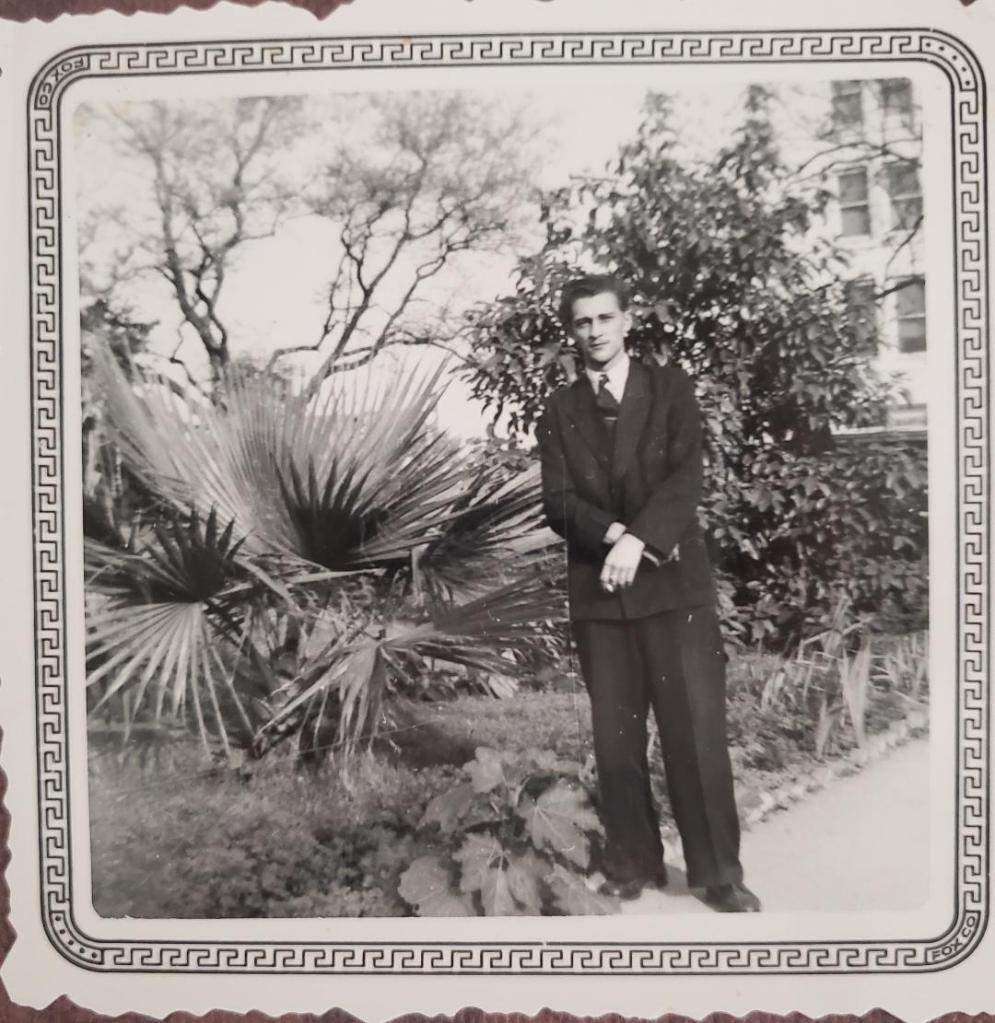
Roland in the U.S.

You will recall that in May of 1952 Roland, my schooltime sweetheart, and his family left for America. I was seventeen at the time; we promised to write to each other, feeling that somehow things would ultimately work out for us.

Originally, the family’s sponsor had arranged for them to move to Togo, Minnesota. As they were about to depart from Germany, however, there was a chicken pox outbreak, and they were quarantined for eight weeks. Meanwhile, their sponsor took another family to Minnesota, and the Frieses made arrangements with a different sponsor.

In his letters I learned that after the Friese family’s arrival in Manhattan, New York, they learned they were going to Bandera, Texas. They traveled by train to the nearby city of San Antonio, Texas where they were collected by the owner of Montague Ranch in Bandera. This is where the family was assigned to work. The three men in the family worked hard as ranch hands and Roland’s mother helped in the house; her youngest child was four years old.

Roland wrote of swimming in the Medina River, sharing it with water-moccasin snakes, often coming across rattlesnakes. He learned to ride horses cowboy style and bear the Texas heat. He wrote of the rancher’s wife fashioning baskets from the carapaces of armadillos, bending their tails to make the handle.

His brother Gerhardt was the first to leave the ranch to find work in San Antonio, where he was employed by Friedrich Refrigeration Company; the remainder of the family followed soon after and Roland began working for the same company.

I for my part had no such exciting things to write about, still being tied up in high school’s humdrum routine. My summer’s excitement was an occasional afternoon at the pool or tennis court in Büdingen.

In the fall Edel and I sometimes walked to Oppelshausen, my aunt Dori’s farm, to help with the apple picking. That was our excuse anyway, we were more interested in fun than actual work. My uncle Robert, who had to give up his study of Jura (jurisprudence) and take over the management of the farm after his brother was killed in a hunting accident, was in the habit of inviting young students from his fraternity to the farm between semesters, and so it happened that I made the acquaintance of a young man who was a student of law in Frankfurt. We joked and laughed while climbing into the apple trees on ladders and filling our sacks. I found this to be a different sort of day from those that had come before – a pleasant interlude – but nothing more.

However, a day or so later a horse and rider appeared at our house in Altenstadt. I knew the horse as one of my Aunt Dori’s before I recognized the rider as the young man in the apple trees, Karlheinz. He brought with him a sack of freshly picked apples for Mutti, a gift from her sister – or perhaps payment for our efforts at helping. My parents invited Karlheinz to stay for afternoon coffee. As they engaged in lively conversation, I would occasionally come into the room with different excuses, trying to hear what they discussed.

When it was time for him to depart, Karlheinz asked if he would be allowed to “come calling” which I graciously granted. I found him entertaining and saw nothing wrong with visiting with this young man, since Roland and I had promised to write and nothing more. Karlheinz mounted his steed and, with a wave, rode away.

I did not think about it any further, certainly not that anything could become of it, as I judged myself, still a teenager, too young for a college man. I had experienced this conundrum already once before, when Papa had declared a suitor too old for me.

So here I had something a little different to write to Roland about. But I certainly never expected the reply I received about two weeks later (remember air mail took 5 to 7 days en route at the time), by which time the incident was no more than a dim memory for me.

Roland was incensed with jealousy, mocking me and the “knight in shining armor on horseback.” He used many ugly words I had never heard out of his mouth. Certainly, his words had the exact opposite result, if they were meant to “reign me in.” I bristled against them in defiance and broke off our long-distance relationship, which was just but a few months old. Consequently, I accepted an invitation, with my parents’ approval, to a fraternity dance my Aunt Dori and Uncle Robert were going to. They would take me along, and I was going to be Karlheinz’s “date.”

At this dance I again observed the behavior of adults in party mode, much the same as I had seen before. I felt more adult in their company, not that this should be mistaken for maturity, but I emulated what I saw around me.

After that dance, I saw Karlheinz several more times. I felt no special sexual attraction for him, but I sensed my parents’ approval and acted accordingly. They had not approved of Roland, and I am sure they were relieved when his family left for America.

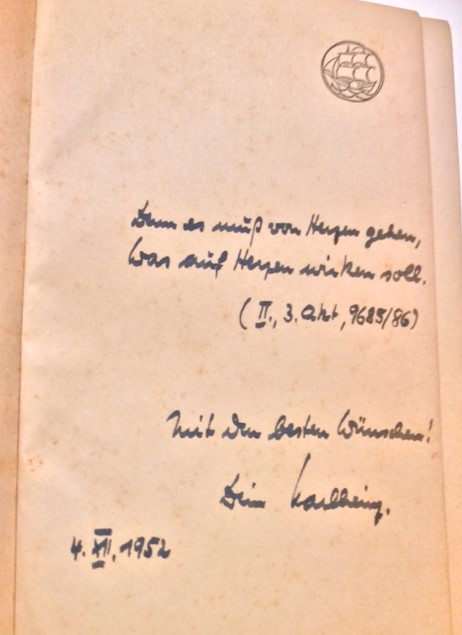
Once I took the train to Frankfurt to meet with Karlheinz to go to the botanical garden. Another time he came to Altenstadt and we walked to Rommelhausen, one of the neighboring villages, and went to a cozy cafe and drank wine and talked for some hours. This man had memorized the largest part of Goethe’s “Faust”, which impressed me immensely.  He gifted me with a copy of the book, bound in silk, for my 18th birthday that December.

“For it has to come from hearts
If it is to act on hearts.
With best wishes,
Your Karlheinz”

Karlheinz was extremely interesting to me, but I began to realize that he had serious intentions and eventually broke up with him.

In 1996, I was in Germany for my Mutti’s funeral, and my 87-year old Aunt Dori stayed with me in Altenstadt. When our reminiscing touched on the farming complex Oppelshausen, which her family had given up many years earlier, I asked Dori if she knew what had become of Karlheinz. She told me that he was a Juvenile Court Judge in Frankfurt.

Perhaps I could have been a judge’s wife…Perhaps I could have been a microbiologist AND a judge’s wife…

I don’t recall how it happened that Roland and I began writing to each other again, but I remember a letter from his mother informing me of his enlistment in the U.S. Army. We would meet again in another year.

Katharina’s Story – Chapter 20: Love Found, Lost, and Revisited

My Mutti once wrote a poem to Papa, when she was young, at home with small children, and he away serving the German army in World War II, possibly in Greece at the time, circa 1942. I would have been about eight years old then, and the family living once again in Kalthof with Papa’s parents, August and Hedwig.

I have this poem still. I call it “Nora Loves Walter.”  Once accompanied by photos from their courtship days, which no one has any longer, it is quite romantic and nostalgic, and I share it with you here:

Remember the bungalow by the sea?
Bright colored wildflowers surround;
Gentle waves tumble on gleaming sand;
White clouds to far away places float.
Like they, you are now far away.

Remember back last blissful May?
We spent together a short little while,
We were so happy here,
Arousing the envy of the gods.

Far distant now you are again
Serving in foreign lands;
Alone I lie in sun and sand,
Sad music in my heart,
Thinking of you all of the time
Wishing you back to my side.

How many tears must I shed
‘Ere you return? – Then
Every  minute we’ll treasure,
A precious gift every hour.
Countless kisses shower on me,
Be tender and loving to me.

We will be happy and we will know
That I am yours and you are mine.
And when you’re far from me again
And I am lonesome in despair
I will forever grateful be
For the happiness we shared.

My pained little heart, do not despair,
All will be good again one day.
And although time drags slowly on
Hold fast to courage and faith.

 With ardent love and deep desire,
This heart yearns and hopes,
Believes firmly in our meeting again,
Though tears of longing too often flow
There must come an end to being apart.
Blissful happiness, my heart, awaits
As you have never known,
When from foreign lands
Your sweetheart will return.

More than forty years later, Mutti and Papa celebrate their 50th wedding anniversary. It is 1985, Nora is 74 years of age, and Walter is 75. At Nora’s suggestion, they each write a contemplative letter to share with the other.

Like many, I have written letters at certain times in my life, to cleanse my thoughts and feelings – but then I would destroy them, never meant to be shared with anyone.

I discovered these, my parents’ missives, after a lifetime. My mother’s letter strikes me as confusing, full of self-pity, repetitive, a jumble of emotion. My father’s letter is logical and sounds much like him; I think he saw himself clearly.

What decades of difficult circumstances have done to the young lovers’ relationship is painful to recognize. The war, having lost all in a night of bombing, leaving home and the summer house on the Baltic Sea to live a primitive life – this was not the life that was imagined. Mutti had been fun-loving, outgoing with friends; she loved to dress in the latest fashion – in her mind she had an image to uphold as the wife of a doctor, a standard to keep, a reputation to create. Her hopes and dreams and plans for a bright future and secure lifestyle, with the comforts befitting the social status of an academic, had been destroyed by ill fate. All those years – the fight for survival, the depravation, and the struggle to start building a new existence in a backward village, had taken their toll.

All this was even more complicated by the friction between Papa’s parents and my mother, in the beginning years of our family life, during the war, and after – well, Mutti yelled. When we came home from school, we could hear her from a distance and we warned each other: Dicke Luft (thick air) – in other words, tread lightly! What she yelled about we did not know; at least it was not about one of us, so we tried to stay out of her way. Papa usually took the brunt of it.

Perhaps Nora yelled to let off steam, out of frustration and hopelessness and a feeling of impotence. I think Walter felt at least in part responsible, and he remained a fortress of commitment, devotion, and loyalty to Nora. Although, it seems, Nora did not see it that way.

But as we each live our lives, we see this phenomenon again and again, no more unusual than any other long-married couple encountering conflicts of personality among and between family, friends, and themselves. We have all lived these things. We will continue to live them, as will our children, and their children, and theirs – for generations to come – no matter what the world looks like.

***

Mutti’s Letter:

When I think about it, why I still live together with this man, I can think of many reasons.  I have said to him: hopes, insurance, promises, aid, little things, tolerance with my changeable temperament, and a few surprises, caresses, and something like “fealty” awakened in me the expectation and confidence that life with such a man could be rewarding and worth all possible efforts.  Why am I still with him?  Because I have taken my promises seriously and had mobilized all of my forces, all imagination and all energy for this life, and still hope and wait for a small amount of understanding and harmony; because I have five kids, from whom I did not want to steal the image of an intact family home.  There are many mundane reasons of many kinds and there is the certainty that now there is no longer any other way.

Despite all the hopes and illusions, efforts, dedication, and loyalty have led to no other conclusion as to ensure that all parties have accepted and benefited from the results; still more inexhaustibly expected and demanded–not kindness, encouragement, let alone recognition mustered; however frequently being criticized and enduring defamatory comment… I remained… Well, there are five children whom I did not want to impair or harm in body or soul.  Only after all this was over it turned out that in him, the characteristics of his parents are joined, on one hand — Heartlessness, selfishness, greed, treachery; on the other hand, rudeness, insincerity (for instance, minimizing the situation, encouraging me to go on; trying to pacify me, engaging in 2-3 days of good behavior; who would not mistake that for good-naturedness or understanding?) until everything went back to the same style.  And always new hope, new courage, new efforts by me… for decades.  Occasionally I would run away out of desperation, but always returned… with new use of all reserves — for the children!  All that could change and help was missing.  The partnership demanded dedication yet he would never say anything to bring order and clarity, even at the expense of conflicts and possible attacks on himself by his parents for providing understanding and sympathy for the wife and mother of his children; he should have personally intervened on behalf of his wife and provided protection for his own family against the interference and hatefulness, meanness and sabotage of his own parents, including their influence upon the children to alienate them from their mother.  A neutral spectator, the Doctor, who stands socially above all, could muster no sign of recognition that they (the parents) have destroyed a life and the hope for a rightful existence and have turned everything that was good and positive into bitterness, rejection, hostility, distrust. . . eventually resulting in indifference, apathy, isolation, misery, resignation. 

The catch:  Even after all these years the promising partner does not want to come out of his comfort zone… and wants to know what in detail, where in detail, and how in detail, he at sometime, somehow, or somewhere should have said or done. 

Conclusion:  No understanding, no empathy, lack of engagement despite ongoing dedication in relation to daily trivia, no dialogue and exchange of thoughts, only the final word.

What partner could be satisfied or at least have the feeling of being taken seriously?  The consequence for the wife… a slow destruction and waiting for the end of this hopeless existence.  Maybe she was a problem without a solution for those around her, but she still seemed to be useful and usable, and toward the end, a welcome whetstone for his own shortcomings, mistakes, failures, frustrations, disappointments, prejudices, resentments… which is pretty useful, too.  Only that this whetstone had a sensitive soul which was slowly destroyed and finally used up and left nothing but a repulsive pile of rubbish.  That is the resumé of a once hopeful, life-embracing, accommodating, unselfish existence which ended in bitterness and disappointment.  The rubbish heap made many mistakes, but the biggest mistake was, despite all the negative experiences, the continued willingness to be there for others.  One should learn from mistakes.  So I will finish what I started, no one should feel guilty.

Maybe convenience, inherited cowardliness, sloth, or egotism are to blame.  Let that be a lesson for you; expect nothing from others. . . from no one . . . trust only yourself and use your own strength.  Don’t count on understanding or acknowledgment; only on everyone’s vanity and love of self.  Shield yourselves against deception and insincerity.  Hold on to your own personality.  Don’t spend your life but live with understanding and common sense so you do not end up as a good-for-nothing heap of rubbish but with the consciousness that your life was worthy.  Guard your soul, your feelings, and your independence.

***

Papa’s Letter:

Who am I?

My 75th birthday has passed.  Guests, children, and close relatives assure me that they enjoyed it in the circle of the large family.  Only Katharina was missing.  My mute but never to be forgotten sorrow is the feeling of guilt concerning the severe injury to my wife, Nora, whom I love so much that tears come when I think about this, like now, but it can never be made good again.  Who am I?  How am I? I have an idea of how others see me because I can sense it in conversation and attitudes.  I was an only child, so it was never necessary for me to assert myself against siblings.  That may be one reason why I am always lacking a quick answer or reaction and my reactions are often misinterpreted.  My answers are slanted and can be taken totally the wrong way.  Then I am dismayed and rendered speechless.  Explanations are then futile.  I am often guilt-ridden because I have evoked reactions to my attitude which I did not want or expect or counted on.  All this is only for my immediate circle, for with strangers I appear confident and must be that way as a physician; how else would anyone trust me?  In that regard, I have longstanding experience of conveying trust and confidence by drawing from examples and my own expertise and personal experiences. 

Sure there are always situations in the family, from long life experience in dealing with the relatives (with a good memory for all the little details) which contradict what is now current.  But I also see what I don’t like in others… what makes me feel uncomfortable.  But I cannot dispute that or reproach a person if it involves something that could damage the family in some way unless I have been asked for advice.  I don’t think getting involved in the intimate matters of the children without being asked is useful.  Generally, a person is sensitive or aggressively rejects unsolicited advice except when he is in danger or a similar situation.  Besides, after 50 years of life experience in a large family, one had to find out that well-meant advice at an earlier time proved at a later date to be not useful or even detrimental. C’est la vie!  Laissez faire! It seems each person has to gather his or her own experiences in order to learn.  If I give advice which later on proves to be disadvantageous or detrimental, it is my fault.  If I do not offer advice which was not solicited, then again, I blame myself for my attitude and again I feel guilty.  Where is the right way for us?  I don’t see one but that does not make me unfeeling or egocentric.  I don’t presume to be a judge or a rule-maker.  I am basically a helpless person.  My seeming authority as the head of the family stands on very, very shaky ground.  I am not even conscious of it, even when I seem to assert it, as I am told.  Perhaps this is a subconscious shield against vulnerability which I suffer from.  But even that scars over quickly enough and leaves no pain, at least not consciously.  I am not a hard person.  I am easily moved to tears when I encounter good deeds and empathy.  Dealing with my patients I have always been able to hide this, because a physician who cries with the family can hardly be helpful.  But it was always really hard.

And if I react that way toward strangers, it is even harder in the family.  Tears are useless when only practical help is needed if one knows how to help.  But how to know?  I have never been fond of making decisions.  In the bottom of my being, I am always doubtful.  My brother-in-law always said, “first, think about it long enough,” and that is probably subconsciously a basic trait of my character.  Only a few times in my life was it necessary for me to make quick decisions.  Shooting a guerrilla, for instance.  Looking at the situation from a danger point of view, it was not absolutely necessary, and it only bothers my conscience in a small way because it was a combat situation.  I am not a hero in any area, I don’t want to be one or even seem one.  I do not feel myself as above others.  I get joy from knowing that our children made something of themselves… all five… and I am proud of that, not because of me or my contribution to it, because they are what they have become out of themselves.  I only played a small part in that… Their education, advice, and guidance.  And when I talk about the success of my children in conversation with friends, it shows my joy and pride, but not as a declaration of my own accomplishment. 

I acknowledge how inept I am in many things of daily life and feel only able with physical work.  It has just come to me that I am a Libra… I always see two sides of everything and try to keep both sides in balance.  I do not believe in astrology.  I do not believe in God.  I only believe in man, and here we are in the area of politics which should be left unsaid.  Is man by nature good or bad?  It seems that he is bad.  The animal is neither good nor bad; it is natural, as he is driven by instinct to survival.  Basically, that is also true for man, only his ability to reason forces him to think ethically.  Such is the duality between natural instincts and man’s ability to reason created.  And each must decide that according to his predisposition.  It is never good nor bad; both are natural, both are not human, but primal. 

Nevertheless, two souls live in my breast (quotation, Faust).  One is egocentric, the other is… Well, what is the opposite of that?  Not altruistic, but societal.  Maybe.  I want to say about myself that I am not egocentric.  Maybe I don’t even possess a healthy ego because I am compassionate.  And out of this sense of compassion, I never do, or leave undone, what is necessary.  If that makes me a good person is doubtful.  I don’t see myself as a good person, but neither as a bad one.  Just common, average.  I have no outstanding abilities except to be able to perform physical labor.  Is that a merit?  So, I am as I am, but do I know myself how I am??? 

Katharina’s Story-Chapter 19: At Odds

Here was the time in my life when my teenage attitudes started to get me into trouble. I had always been a bit bull-headed, and the tiniest bit of a black sheep. I had the idea that when I graduated, I would be running off to America to join Roland (which I did eventually do, and that story will come, dear Reader).

Now that my head was full of dreams of love and adventure, time could not move fast enough, and I had the notion that I was outgrowing the parent house.

Mutti and Papa had recently joined the tennis club in Büdingen. This brought into my life some limited extracurricular activity. I enjoyed the sport of tennis, and with it came the promise of social events the club held on an annual basis. It was at these events, for instance, the Christmas Ball and the costume dance at Fasching (Mardi Gras) in February, that I began to pay more attention to how married couples behaved. I had the opportunity to observe the less constrained behavior of adults in a relaxed environment.

There was wine and smoking, laughing and joking, dancing and fun. Couples intermingled, switched dance partners, sometimes found a hidden corner and smooched with someone else’s husband or wife. I assumed this was accepted conduct. Frau Kolb, the wife of a prominent attorney, when she had had enough wine, would take her top off, baring her buxom self from the waist up – she’d do this in the middle of the dance floor. Her husband had to take her home.

Here I knew most people, not like at the dance of the medical association where I debuted. This was a less formal affair as well, no evening attire, but cocktail dresses. I was having a lot of fun. I was a good dancer and enjoyed it. Observing how married couples behaved in party mode, dancing and joking and laughing and flirting amongst each other, I saw nothing wrong with having been a bit uninhibited with Roland at our meetings. Being involved with the club opened a door that had previously been closed to me. It gave me a fresh look at the adult world I was beginning to be part of. I took on a bit of an all-knowing swagger, regardless that I was not of an age to make any serious decisions about my life.

There was not much interaction with my parents around life’s decision-making. Yet when I did something I was not supposed to, or something that was not expected of me – like I should have known better – Mutti would be the one to deliver a sermon that was forever long. I would sit and listen, but not hear, or not want to hear. I dreaded these long interludes of course, but I was never able to say why I had done something. I never tried to explain, probably because I didn’t know myself what I was thinking.

Papa was not a man of many words, especially when it came to juvenile female behavior. His quiet presence at Mutti’s sermons was more for Mutti’s support and confirmation of her assessment, rather than an opportunity to discipline or provide guidance. There was however one interaction I had with him alone, during this time, which surprised me and showed me another side of him. We were entering the house together, and I don’t remember what the occasion was, but I made some sort of smart, impudent remark, and he hauled off and slapped my face hard enough to make my ears ring, without saying a word.

Oh, my parents! They were very opposite personalities, and I frowned at both at different times for different reasons. I spent a great deal more time with my mother; she was the one who assigned the chores. This made it seem that any time spent with my father was more special, but as far as teaching us her skills, Mutti was as patient as Papa.

Papa taught his children many things about mushrooms and edible plants, about camping and kayaking and sailing. He taught me how to drive a car, even though I was too young to get a license.

He was always wonderful at explaining, at encouraging anything any of us showed interest in. Once he and Hardy worked together at building components for a radio.

Mutti had ideas about making furniture, ideas that Papa would make reality, like building a sectional couch from apple crates and mattresses.

In his practice back then Papa did blood work, the type that laboratories do today, on his microscope, using dye to make smears on the slide that give each blood corpuscle definition. He taught me how to read the slides, working in a grid, to identify and count the different blood corpuscles. He used this blood count as a tool for his diagnosis. I became fascinated with the microscope, and he would show me what the fungus or mold that makes cabbage into sauerkraut looks like, and other things like that. I became proficient at doing the bloodwork for him, but before he trusted me completely with it, he redid it himself to make sure I had done it correctly. Eventually he paid me one Mark for each one I did. Papa gave me books to read and suggested that I look into the field of microbiology as a career; this was about the time electron microscopes came into use, which had much greater magnification power.

He also employed me as his bill collector. Private patients, the ones with no insurance, were sent a bill for Papa’s services and sometimes they were a little tardy in paying. Papa would take me along when making house calls in the other villages, leaving me with a stack of bills and directions to find the right addresses from which to collect. Sometimes I was attacked by geese – or rather, the gander – and barked at by mean dogs tearing at their chains, but most of the time I was able to collect, and my payment for this service was the amount of postage saved.

As I sit here today, I realize I am older now than either of my parents lived to be. What would I say to them today if they were alive?

To Mutti,

I am so very different from you, where you are sensitive, I am inconsiderate, where you are delicate, I am hardheaded, where you are logical, I am erratic — you act from reason, and I act from emotion.

But you have taught me every skill, sewing and cooking, reusing and repurposing things with imagination, frugality and creativity, lots of practical life skills. What was lacking was any kind of sex education, which now seems astonishing to me, especially since you yourself got pregnant with me at a time when I think you had not planned on starting a family. It seems you should have wanted to keep your daughters from the same fate by at least teaching us about contraceptives. Having brothers, I knew what a boy’s penis looks like, but not a man’s and how it gets ready for intercourse. You showed me how to handle menstruation but did not explain anything more than that it made my body able to have babies. I knew nothing of these inexplicable senses of urgency in my body at times, which were part of the physiological female nature, like a dog being in heat. I did not know how to handle them. You branded me “man-crazy” because of it, because I seemed to respond to every boy’s advances. Maybe you did not feel this as strongly in your youth and could not understand.

I used to think that your marriage was a happy one, the way you and Papa worked together at making a new living for us in Altenstadt after the war. Although we all sensed that there was something not right, we had no way of knowing that the poisoned relationship with Oma, our father’s mother, was the deep-seated reason for your bad moods and angry outbursts, so we just steered clear. I promised myself I would never lose my temper like that. I noticed how you oftentimes shrugged it off when Papa tried to caress your shoulders and neck. I knew I did not want that in my marriage. I longed for touch, for tenderness.

I admired you in so many ways: the way you got us all safely out of Königsberg in time, the creative way you made that old house in Altenstadt into a cozy home, despite how primitive everything was — no indoor plumbing, only cold running water, close quarters for such a large family especially after you took in Oma and Opa too, all the while making do with very little.

I regret very much that we were never really close in adulthood. There was always that biting criticism of yours that kept me from confiding in you. You were right about the men I chose. I know now they were not right for me, but I was never able to tell you of all my heartache because I was afraid of your “I told you so” attitude.

It was impossible for me to just come over for afternoon coffee the way you used to go back to your mother’s house in Königsberg sometimes. I remember those times and the laughter in your mother’s house.

***

To Papa,

I have been told that I take after you in some character traits: introverted, stoic, taciturn. I remember you in my life when I was five and six years old, your eldest child, when you showed me caterpillars, took me kite flying and taught me skiing on my first short skis. After that time, because of the war, you were not present much in my life until we ended up in Altenstadt. Once we got settled in the house on Haupt Straβe and your medical practice got going, I remember you reading entire novels to us in the evenings while I was knitting, and Mutti was busy with some hand sewing.

You taught me how to do the bloodwork for you with the microscope, you had me help you with bill-collecting in the outlying villages. We never talked very much, but I liked that I was able to do these things with you, and especially the part where you paid me a small amount of money for doing it. It made me feel a little grown-up, being able to do something that was worth being paid for. And you were a different person away from the family.

I remember playing mixed doubles at tennis tournaments with you and messing up a lot of serves. You could have done better with someone else, but you chose me as a partner.

I am sorry if I disappointed you in not choosing to go to college and pursue a career in microbiology, as you suggested. I know it would have been a good choice with the electron microscope having been invented, making important progress for medicine. During my school years in Büdingen I did not find a special talent or skill or passion in myself that made me want to go to college at all. And it seemed to me that the main reason a girl went to university was to find a suitable husband. That made sense to me, living in Altenstadt, since there were no suitable young men available there.

But I had someone — someone I know you did not approve of for me – but someone who wanted to take me to America. I never felt at home in Altenstadt, not the way Königsberg felt to me, as a child. I believed I was grown-up enough and confident enough to take the big step, to move away from home. Anyway, I thought a wife’s place was with her husband, wherever that might be. And in my years in Germany, the challenges and difficulties our family faced in those hard years after the war taught me much and made me anxious to start my life away from the parent house.

I think the times you came to visit me in America, you saw that I was doing things I was passionate about, close to the things I learned as a very young girl in Kalthof with Opa; the caring for animals and the growing of food, making a healthy living in harmony with nature. And you were proud of me, Papa!

Katharina’s Story – Chapter 18: Roland

I was sixteen when I met Roland, in the summer of 1951. Our school celebrated its 350th anniversary, and this event included several days of sports and recreational activities for the students. A special train excursion for the upper classes to the cavern in the Sauerland was part of it. This train, the Samba-Zug, featured a dance car with great appeal for the young crowd to make the long hours go by more quickly. In an otherwise empty car, a disc jockey, a record player and plenty of 45 rpm records of popular music made for a perfect dance venue. It was well attended and, since I loved to dance, I was part of it.

I was standing by the window, looking out at the landscape speeding by, captivated by the rhythmical sound of the steam engine and the tuck-tuck of the wheels going over the joints of the rails, a rhythm that on many early morning train rides to school during winter months would threaten to lull me to sleep. Turning away from the window, I looked out into the milling of fellow students on the dance floor and found a pair of eyes fixed on me from across the way. I held the gaze and felt struck by surprise and a curious interest.

He was standing there next to Helmut, a young man from the Obersekunda, one year ahead of me, with whom I had danced a few times. He was taller than Helmut, had dark wavy hair and a look in his eyes that somehow attracted me. He walked over and asked me for the next dance. I accepted, of course, and learned that his name was Roland, an old Germanic name, a name of legendary heroes. He was eighteen.

I always had a quirky tendency to look for unusual details and noticed that the back of his neck appeared as if it had not seen a washcloth for quite some time. I thought of Mutti, always reminding the boys to wash behind their ears – perhaps they should also be reminded to wash the back of their neck. A thought wandered through my mind: “Would I darn his socks?”

Roland told me that he was in a class above mine – Unterprima – two years from graduation (I was in Untersekunda, four years from graduation). He lived in Düdelsheim, a village I passed through every day riding my bike to school during the warmer months of the year. We talked of mutual acquaintances, and an envy rolled through me — the girls in the class a year ahead of me, always nicely turned out: the twins – Mac and Gies – who dressed the same and were hard to tell apart; Renate, a talented piano player, dark haired and blue-eyed. I later found out that Roland had a crush on all of them but held an especially deep affection for Mac. They were not on this trip, thankfully, as I could not think how I could possibly be more attractive than they. I was dressed in dark-green corduroy Sambahosen – what might be called pedal pushers today. My Mutti had sewn them special for this occasion; they were practical but certainly not very feminine at a time when skirts were still very much the required attire for schoolgirls.

During the remainder of the train trip, I continued to dance with both Helmut and Roland, and the three of us stayed together when we arrived at our destination. Together we went into the cavern in Attendorn, each of the guys holding on to one of my hands.

Caverns at the Sauerland, Attendorner Tropfsteinhöhle

Oh, how special I was feeling! I had no preference for either one at the time, so I kept them both in tow. It did seem a bit strange to me though, like I should choose one or the other; sort of embarrassing, sort of exciting, so very enchanting that I should have them both interested, at a time when I was so filled with an unexplainable need to attract any boy’s attention.

I paid little mind to the guide, who moved through the caverns explaining stalactites and stalagmites, the geology and climatic conditions that create these wonders inside the Earth, and the dangers the spelunking explorers had faced. I was in my own dangerous space, that place where I am trying on boys like clothing, in a puzzling mix of curiosity, anticipation and apprehension.

The train ride back was much the same as the one going up. We talked and danced; Helmut sort of quiet and easy-going; Roland more tense and somehow dark and moody – two very much opposite characters. The arrival back in Büdingen ended the excitement of the day quite abruptly with each of us going back to our own classmates, without having made any other plans.

School resumed its usual pace. The train excursion was a pleasant interlude, now relegated to the back of my mind. Much time passed before I saw Roland again, but one day, as I was coasting my bike down the hill on Hauptstrasse into Düdelsheim on the way to school, I caught up with him. I was not expecting to see him; he was on his bike as well, just leaving for school. We rode side by side, after the first smiling greeting, not saying much. I was very self-conscious and somewhat uncomfortable, not knowing what to talk about. It was not my way to ask questions. Instead, I would wait for a person to share what they were willing to share, and then I would do likewise. He did not have much to say either, but it happened that we rode together many times after that. After school, I would look for him, but I did not find him. Nevertheless, I was glad to see him whenever I did.

That summer I gradually learned that Roland lived with his mother, father and two brothers in a room that had been assigned to them as refugees from Sudetenland Czechoslovakia. All remaining Germans had been driven out of that country by the Russians, after Germany lost the Second World War. West Germans with space to accommodate them were required by the German government to take in these refugees from the eastern regions. The Friese family lived in an upstairs room of a farmhouse in Düdelsheim. Three other refugee families lived in that same farmhouse.

Roland also had a sister living in Düdelsheim, married to a local man, with whom she had two sons. His younger brother was still in grade school. Roland himself was working after school on the American Army Base, setting pins at the bowling alley there, to help his family with money. That, and the fact that he smoked American cigarettes made him seem very grown-up to me. He had become quite friendly with some of the soldiers on Base, and his school English was colored with an American drawl. He was altogether alluring to an adventurous girl with a head and heart filled with dreams.

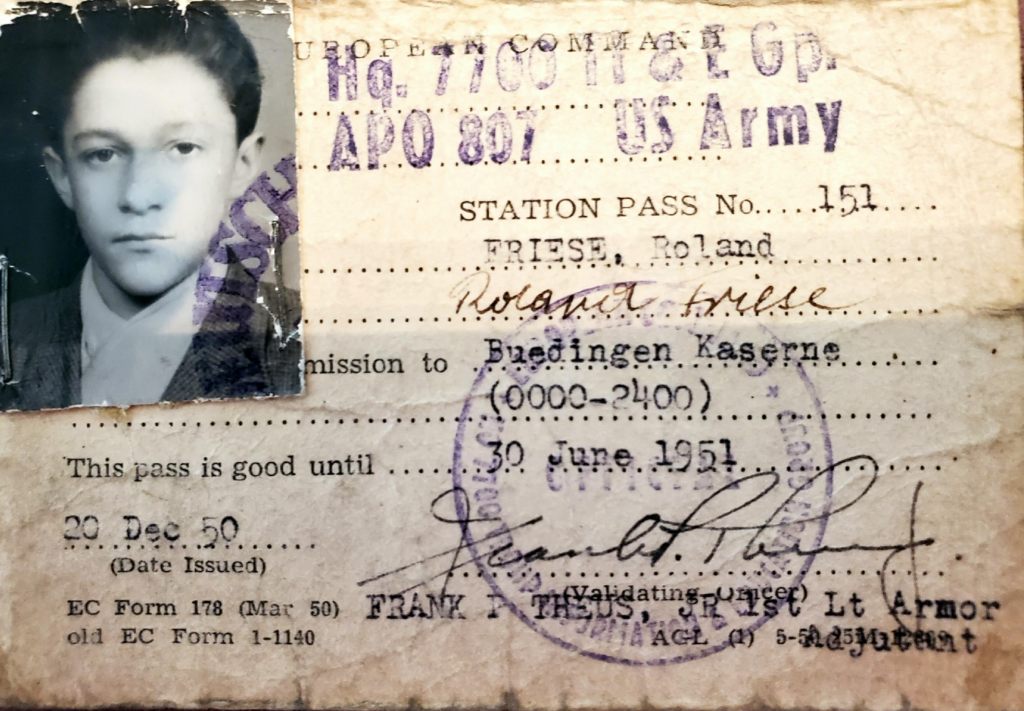
Roland’s station pass for the American Base in summer 1951.

Frau Rauch, one of my English teachers, had been making class more interesting by introducing us to some American music hits from the 1940’s, songs like “The Old Lamp Lighter,” a song about “the moon above the Wabash,” and others. This sparked my curiosity, and I started listening to the American radio channel late at night, after my parents had gone to sleep and I was the only one up doing homework. Papa abhorred this music, terming it “hillbilly” music, but to me it sounded so new and different. With Roland being in such close contact with the American ways, well, I suppose that was something else that made him more attractive to me, igniting that spark of daring spirit.

We saw each other at the swimming pool during summer vacation, where many of Roland’s classmates where present. Helmut was there too and another friend of Roland’s called Sheriff, and the stunning girls. One young lady, one of the Von Hollenbens in her bikini, tall, small-hipped, lithe but chesty, seemed to excite the boys to the point that they would have to get up from where they lay on the grass and, in a sort of bent-over posture, head for the pool to cool off. Sometimes I felt an intruder in this group of friends, but Roland’s closeness comforted me.

A few times that summer we rode our bikes out on one of the country roads out of Büdingen, where we would find a sunny clearing in the woods to lie down. I felt wanted, and Roland satisfied a great need in me for touch and physical closeness. In this state of mutual dependency, we fell in love.

It was a glorious summer that too soon came to an end. The Friese family had decided to emigrate to the United States. Emigrating families were required to have sponsors in America who would guarantee them work and housing. Roland’s parents had applied and were matched with a sponsor through the Catholic Church. To be eligible, the family must have been born behind the Iron Curtain, must have lost everything due to the war, and must have three men over the age of eighteen who were able to work. The Friese family qualified; Roland’s sister, however, now married to a West German, was not eligible to come along. Roland would be leaving the country in the spring.

He left school after the summer break and took a room in Büdingen to work full time at the American Base (presumably what was known as Armstrong Barracks). It was during this time that the family’s paperwork was being processed. They would need more funds for the journey.

Now nineteen years of age and independent from his family, and in steady association with the American soldiers, Roland seemed to develop a taste for alcohol. I did not see him much during the winter months of 1951/52, but one day, when we were meant to get together, I was told that he was very sick with alcohol poisoning. I found out where he was rooming and went to see him. It was a narrow room with just a bed, a small table, and a chair, with some hooks on the wall. He lay in bed, the room reeking, grey as ash, a sorry sight indeed. But he seemed to be getting over it and was obviously very embarrassed to see me there. Not knowing what I could do for him, I did not stay long.

In the spring of 1952, the time came for the family to leave Düdelsheim and move to a facility in Hanau for processing. Roland offered me his bicycle for 80 Marks. It was a man’s street bike with 26” wheels, small diameter tires and three gears, of which only the largest gear was operable. I asked Mutti and Papa if they would get it for me, and they did, to help the family financially. I passed my own bike to Edel, and started riding the bigger bicycle to school, swinging my leg up over the saddle just like the boys did. The gear ratio built more muscle in my thighs and shaved off some time to get to Büdingen. I suppose this would be an indication of how tomboyish I was, even then, as a young lady, now seventeen.

I took the train several times to Hanau to see Roland before the family left in May. We had promised to write, and we did so regularly. Each letter took about a week by airmail to arrive.

The family traveled by sea on the USS General Harry Taylor. It was a seven-day trip across the Atlantic. During the voyage, Roland and his older brother worked as interpreters, while his parents worked in the kitchen. The passage was free, but the transport of luggage – although a very spare amount of belongings – would cost the family $600 to retrieve. Upon arrival at the train station in Manhattan, the Frieses were told they were going to Bandera, Texas, and each member of the family was given ten dollars.

Roland’s departure to America did not seem to change much between us. Certainly, knowing him filled a void in my life. I had no girlfriend and did not know of anyone in whom I could confide about the beliefs a girl holds, the dreams and hopes for the future, the visions of husband and family, a life beyond school and parent house. All these things I kept to myself, only knowing that I would be willing to invest myself completely, adjust where necessary and be tolerant. Roland and I had made no real plans, had had no deep discussions in the limited times that we spent together, yet we figured somehow things would work out for us, even if it seemed unlikely at the time. We would write – and I would dream. I was seventeen, naïve, full of ideals and oh-so-confident.

Katharina’s Story: Chapter 17 – Growing Pains

Altenstadt, Hessen, Germany

Altenstadt. Being a small village there was little offered in the way of entertainment; there was sort of an improvised movie house, upstairs in an older building, with rows of plain chairs. Once a year there was the Kerb, short for Kirmis in the Hessian dialect. The Kerb had initially been, as I had been told, an anniversary celebration of the completion of the construction of the Lutheran church. Nowadays it has little to do with church. Every village had their Kerb, and as part of it, a carnival with merry-go-rounds and swings and booths of all kinds was set up, there was a dance at night and much drinking.

Once in a great while a small circus would come, and on this occasion, Hardy and I went to the circus tent. There were acts with horses, of course, and I was thinking how great it would be to travel with a circus, be around horses all the time, seriously considering running away with the circus. Hardy went home after the end of the performance, but I found a way to hang around, without him finding me. Seems that he had appointed himself my chaperone and protector. I found my way to the tent where the horses were stabled, mostly by following my nose, I loved the way they smelled! I snuck inside and sat on a bale of hay in the dark, smelling the horses and listening to their soft snufflings. It was a long time before one of the stable boys came in and noticed me. He sat down beside me. I did not move. Maybe he took that as an invitation to move closer and put an arm around me. I felt accepted for some strange reason or maybe out of some deeper need. But then things got a little uncomfortable when his intentions became clearer. I extricated myself and went home then.  It was nearly midnight.

I received a long sermon from Mutti for my waywardness. She was obviously worried by my unexpected behavior; after all, I was almost a young woman at fifteen. She gave me many, but I don’t remember all the reasons why I should not have stayed out that late. Mutti imagined all kinds of situations I could have gotten into. Perhaps she even suspected that I had gotten myself into a situation! I was alternately defiant and silent. Papa was sitting there too, off to the side a bit and silent as I. Never, even in the future, could I come up with any reasonable justification for my actions. Mutti always made such good sense, while I seemed to be always acting out of feelings and impulses.

I am sixteen now. In Altenstadt they offer a dancing class upstairs above the huge hall where the big presses are that squeeze apples to juice in the fall. My parents sign me up. The teacher is a slight, older man in dance slippers. The girls sit on one side of the hall, the boys on the other. There is a shortage of boys. To help with this problem a few older local gents appear. I feel just as clumsy as most pupils. You put two clumsies together and you get awkward in the highest degree. No matter how often our teacher shows us the steps as soon as we are paired up, it is disaster! One of the three older men approaches me and asks for the next dance. I accept and, in his lead, I find the rhythm and all the right steps. His name is Alfons Rheede, and he is 24 years old; we dance a lot together.

With Alfons, I learn the swing, the foxtrot, the waltz and the tango, even the quadrille and the modern samba and raspa and graduate. One Sunday he comes by our house and asks if I would like to go for a walk with him. Surprisingly, my parents give permission, and we walk on the road toward the airport, then take a foot path into a forested area, where the ground is soft and the air spicy with the scent of pines. We sit on the grass in a sunny clearing. He tells me that he works for the forest service, sometimes gets to shoot a hare or deer. Once he brings a hare to the house. He also is one of Papa’s patients. We meet a few more times and then I don’t see him anymore. I wonder what happened and have no way to get in touch with him. It would not be fitting anyway. The only conclusion I can draw is that I am not worthy.

Years later Papa tells me that Alfons had asked for my hand in marriage and Papa refused, because he was too old for me and, anyway, he would likely not be able to support me in the style that I was entitled to. There it is again, this separation of the classes.

Those days, living like a lot of the villagers without indoor plumbing except for cold water, I don’t feel special at all, certainly not entitled. I only feel left out, left out from friendships in Büdingen, left out from associating with the locals. I start looking at the boys. If one looks at me twice, I imagine him as a husband. I hated darning socks, which in those days was necessary often. So, if a boy looked at me, I checked in with myself to see if I would darn his socks. If yes, maybe I’d take a chance. I wonder how many girls these days measure relationship potential on whether they would be willing to darn socks! I expect the bar is the same, just the unit of measurement has changed with the times. How much will you sacrifice of yourself? Have we altogether lowered our bar, ladies?

At school I had gotten friendly with a girl, whose family had also come from East Prussia; she had an older half-brother. He was going to trade school specializing in agriculture. I got friendly with Karlheinz, he was very quiet and shy. His quietude sort of appealed to me, being used to a lot of noise at our house. We went for walks sometimes after school, his and mine, holding hands. He graduated and invited me to their celebration which was going to be held in a Gaststaette, a lounge, on the edge of town. I told my parents about it and asked if I could go: “How will you get there? Will he pick you up?” I answer, “I don’t know, trains don’t run that late, and no he can’t pick me up, Papa could you take me and bring me home again?” After a lot of discussion Papa agrees to take me and collect me from the Gaststaette at 11 p.m. “No later!”

As it turned out, the place was no more than a beer joint, smelly and smoky. There were a lot of single men, some with girls. Everyone was drinking, and records were played for music. “Dancing” was shuffling and smooching, couples clinging together messily.  I knew no-one, and I found the atmosphere oppressive. But I was with my guy, even though I barely knew him. I did not fit in, and the evening dragged on for me. I was glad when Papa came to take me home.

Not long after, Karlheinz told me that he was emigrating to Canada. I saw him again before he left, and he promised that we would write, and we exchanged a few letters by air mail. Presently, he wrote that the daughter of the rancher for whom he worked had taken a liking to him and he would not write to me anymore.

Many years later, after I was already married and living in the United States, my parents forwarded a letter from Karlheinz. . . he wanted to “pick up with me again; the involvement with that other girl had not worked out.” This missive, had it come earlier in my life, may have changed the path upon which this young woman ultimately embarked.

***

Papa’s practice is growing, his patients come from several villages within a circle of about eight kilometers and he makes house calls when needed as well, even in the middle of the night. He belongs to a medical association with a membership of doctors in the larger district. This organization now sponsors an annual dance, and the first one is to be held in Bad Nauheim, a resort town with natural springs with healing properties. Papa receives an invitation. This is a welcome event for Mutti, something that she has been dreaming about, something more suited and fitting her position. This is also the occasion on which I, as a sixteen-year-old young lady, will be introduced to society, it will be my coming-out party. So that’s what had been planned with the dance lessons earlier that year!

Mutti, always fashion conscious, starts to buy fabrics and patterns to sew our evening dresses for the dance. I remember my dress: the material is taffeta, shimmering sea-green and pink threads interwoven, with pink polka dots. It has a rounded neckline with a ruffle of the same material around it, the same ruffle finishes the bottom hem of the ankle-length dress. No heels for me though, I get some new white flats and a small white evening bag for comb and handkerchief. On the day of the dance Mutti and I go to the hairdresser. I get my hair washed professionally for the first time. It was cut short and curled. I feel extravagant.

Katharina at 16
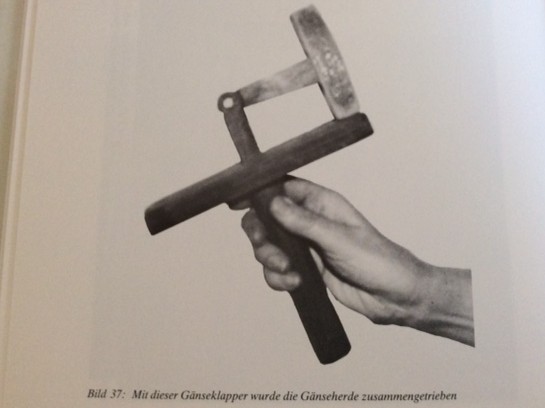
We are introduced upon arriving at the dance hall, and my parents quickly strike up a conversation with the other couple at our table. Wine is served, the band begins to play. It begins with a polonaise around the room with more and more couples joining in as we go. Mutti and Papa make a striking couple on the dance floor, they dance beautifully together and Mutti visibly glows. A gentleman makes his way toward me. He is middle-aged and of a portly build. He asks me for this dance: a waltz. I am delighted but a bit nervous. He leads me to the middle of the dance floor and puts his right arm around my back and starts to lead me first slowly, then twirls me faster in right circles and left circles and this way and that. He is so sure and light on his feet and he takes me along effortlessly, my feet seem to barely touch the floor. And around and around he twirls me. It is the best and easiest waltz I have ever danced!

Papa dances with me; I also get asked a lot by other men. One young man was a student at the University in Giessen, studying to be a veterinarian. We danced many times and talked much of the night. At the end of the evening, he promised to stay in touch, but I never heard from him again. I was probably too young and green for him. It was such a disappointment for me!

The heart of a young girl is a puzzling thing, muddled with idealism, dreams, imagination, yearnings, and expectations. She is uninhibited, yet unknowing that these are the headwaters of the stream that will take her to the pre-destined purpose of the female being, to be fruitful. Searching for an answer to these questions in day-to-day reality only leads to disappointment and disillusions. Did I know what I wanted or needed from a boy? No, I did not. But it seems that what I got was not enough.

I was too in love with the idea of love to realize what love’s realities are. I didn’t know that what I needed were tenderness and closeness, a connection of “being,” not just an occasional connection of bodies. As a girl it is frustrating being in search of something, not knowing what the “something” is, and not knowing how or where to find it. Do you find it in yourself, or do you find it in a partner? Do you find it in a place, or do you find in a situation, or an occupation? What you are really looking for is yourself. Who are you? How are you? What are you capable of ? What are your principles? Do you have any principles? What are your limitations? What is it that you need to make you complete? Could it be motherhood? No one has a real explanation. They say, “you are too young;” they call it “growing pains;” they say, “stop dreaming.”

In a book I read a story of a young couple on a lonely beach entwined, “and the earth moved under them.” That is the way I wanted it to be, I wanted the earth to move!!

Then I read a story that tells of a couple being married, an arrangement by their parents; after the celebration they go to bed. The young bride falls asleep and is awakened in the middle of the night by a brutal attack upon her body, the new husband claiming his right. The innocent naive girl is frightened and appalled, her mate now fast asleep and snoring. Had she not read the love poems and odes of love to adored ladies? Are we girls being misled by those sweet words, being spun into a web of promises?

In later years I “hang out” with another local guy, with nothing going on except making my reputation worse. I enjoyed it, maybe needed it when a boy showed interest, and I responded without hesitation. Most of the time that did not last long, and he was discarded without thought, other times the boy’s interest was not what I thought it was. There were two fellows, at different times, both avid photographers who were only interested in taking my picture, but that was flattering too. I was trying boys on like a piece of clothing to see what fit, what suited me. I was not averse to some fondling and kissing, all this on a purely sensual level, no emotional or intellectual involvement. At the same time, I tried out my own body’s responses.

This exploration spread out over years, and in the meantime, I wondered vaguely from time to time, what others were thinking about, how their lives were being formed; a foggy perception of life after school continued to allude me. I just drifted from one day to the next, without looking much further than the next day or the next week, or what would come after graduation.

My realization now is there is no way you can know yourself as young person. Life is evolution. You learn, you grow in body and mind, you change, events and people change you, your attitude, your capacity for empathy and tolerance. This can work in a positive or negative way, depending on the influences exerted on you over time.

Katharina’s Story: Chapter 16 – Wanderings

Circa 1950: Katharina at sixteen
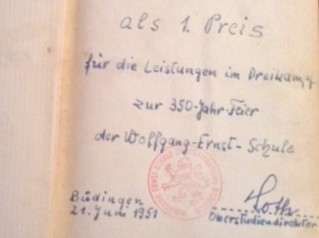
I have always been curious about the world around me. Rarely was I intimidated, and if I was, I forged ahead anyway, just to see what might happen. I was eager to learn about anything and everything. I tried to take charge of my environment; succeeding I think, but at the time of the challenge, it may not have seemed so to me.

As a very young child, when I was told not to lick the iron handrail by the front door in freezing weather because my tongue would stick to it — I had to try it anyway just to see – and it did! It was raw for several days.

My Mutti — Nora — was busy having babies and caring for the little ones that she had little time for us older two, me and my brother Hardy. Mutti seemed to me a robotic parent, tending automatically to the requirements of motherhood, without much holding, loving, or sharing of whimsies. All things were arranged. Clothes were put out for me; I had no choice in what to wear. Everything was done for me. I did not participate in daily incidentals, and I was not asked for input.

When we lived in Allenstein Papa spent time with us, showing us how things worked and explaining the natural world. We worked in the garden, flew kites, and learned how to ski. Even at four and five years of age, Hardy and I had freedom for exploring around the duck pond across the street.

I remember on a warm summer day Mutti sitting on the bank of the River Alle there, in the grass. Hardy and I were catching grasshoppers for Papa’s fishing line — later we played in the water. It was about knee deep to us, and swift. Hardy slipped and fell in face first while trying to catch an eel. Mutti told me later that I pulled him out, “saving his life.”

When I started first grade in Allenstein, and second grade, in Königsberg, life was orderly. Then Papa was conscripted into the war in 1942.

In Kalthof  Mutti was seldom around, there was lots to do. Hardy and were left to pretty much do what we wanted. I had many interests and liked to observe everyone at Gärtnerei Podack at their work. I was inquisitive and followed around with many questions.

In the kitchen I liked to sample things, like the margarine that was used on the bread for the workers, while we had butter. I had to taste it. There was a bottle, it looked like the beer bottles Opa had in the entry hall. This bottle was way back in the corner on top of a high cabinet by the pantry. This kind of bottle had a bail, a porcelain top with a red rubber washer around it. Curiosity about this bottle overwhelmed me. Why was it hidden so far from the other bottles? I took it down when no one was around, opened it and had a small sip. It was like fire going down my throat!! Aaauuugh!! 

When I think back now, it could have been Brennspiritus (denatured alcohol) or some such, that was used to singe hairy feathers off a butchered chicken, that fine fuzz that remains after the feathers have been plucked. I had seen Oma do that once; it burned with a pretty blue flame. In my throat the burning did not seem so pretty!

I guess I was a little wild, not girlish. Obedient in school, a good student. In Königsberg I had been taught to navigate the streetcar system through town, to get to school – even to the dentist once or twice. I was carefree and happy, uninhibited, but I guess I had a little mean streak in me, too. Without hesitation, I followed Hardy’s lead (in the same way I followed him on all adventures and explorations) when we teased the Pflichtmaedchen to tears, or aggravated Oma to the point that she threw her slippers at us.

Hardy was the instigator in most things. Once he got mad and emptied the terrarium out on the carpet, leaving it for someone else to clean it up, and I cheered him on. I have always been a follower, not a leader.

This may not have served me well in the long run.

What does the young Katharina think of herself? She is pliable, accommodating, always trying to make things work out. She has a hard time saying “no,” yet stubborn at times. Trusting, looking for the good in people. Romantic and idealistic in her youth, acting from feelings more than reason or logic.  

With projects, she is practical and realistic, but not very imaginative. Not particularly ambitious, except early on in school and at sports. She is sort of aimless, drifting, going with the flow. Reacting, not initiating. Easily swayed, always doubting, second-guessing herself. She feels she is plain, simple, nothing special, left out.

She is sentimental and loves nature. But has no depth of feeling for religion or a higher power.

She has no sense for direction and a bad memory for names of people and places. She is punctual, though, and skilled in many things, but excellent in none.

And these characteristics, be they attributes or flaws, have remained with Katharina into her elder years. Stumbling along, picking up little snippets of real-life experience here and there. But she has been sustained with a ferocious sense of idealism and complete optimism – I can handle it. Whatever comes. It will work out.

***

I am in high school in Büdingen, circa 1950. It is early summer, and I ride my bike to and from school, 14 km from Altenstadt, where I live. Fritz Lau and his wife Elsa are friends of our family, members of the tennis club, as are we. They also came from East Prussia and had met Mutti and Papa in Frankfurt at a gathering of refugees from our homeland several years back. The Laus live in an apartment in Büdingen on the Bahnhofstraße, second floor up. I have a message from my parents to deliver there after school.

When I ring the doorbell Jutta, their teen daughter, answers the door and asks me in, leading me into the kitchen. Frau Lau greets me, and I deliver the message from my parents. We exchange a few pleasantries and before I turn to leave, I ask to use the rest room. Frau Lau tells me that it is located on the landing a half flight of stairs down, shared with other tenants. Jutta takes a partial roll of toilet paper from the cupboard and holds it out to me. I do not take it, saying I will not need it. Jutta is still offering it, then looks at her mother who almost imperceptibly shakes her head.

I accept the key to the facility and head for the door, use the toilet and return the key with my thanks. We only have cut-up newspaper in the out-house in Altenstadt. That is rough enough using it just for the big jobs, and I was unfamiliar with the appropriate uses for toilet paper. Frau Lau had spared me some embarrassment with her discreet gesture. But it also made it poignantly obvious to me how much our home life set me apart from the more cultivated ways of my classmates in Büdingen.

***

For one summer vacation our parents had planned a camping trip that included Hardy and me. Mutti and Papa took the back seats out of the Volkswagen that Papa was using now for his house calls in the surrounding villages and loaded the car up with camping gear. This included a Faltboot, a 2-seater kayak, which came apart into manageable pieces of luggage to be easily transported and then reassembled. This weekend Papa drove us to the Edertalsperre, and we camped below the dam. The following morning, I decided to go for a swim. I put on my swimsuit and dove headfirst into the clear water, only to quickly realize the shock of the almost freezing temperature of the water immediately below the dam! I made a fast U-turn and got back on land blue-lipped and shivering.

After breakfast we assembled the kayak, stowed the tent, a change of clothes, rain gear and some supplies in the boat and – with explicit instructions for do’s and don’ts, a list of camp sites and a map of the river’s locks – were sent on our water-way heading downstream on the river.  We were to meet up with our parents again in Bremen at the end of the trip. Just Hardy and me in one tent, with no way of communicating with home and no escape from each other. I was not yet sixteen years of age.  

Katharina conducts portage of the kayak. This time it was easy, with a cart on rails. Not all portage events were like that.

The River Eder is regulated: the current gentle. It flows into the River Fulda, the Fulda into the River Weser. On the Weser there are eight hydroelectric plants at the dams and locks to accommodate light ship traffic. We had a set goal to reach every day. The first day we found that the camping place planned for us was already full and we had to keep going. With evening approaching we were looking for a likely spot to camp along the bank and finally found such a place, a pasture on the water’s edge that seemed to have easy access. We pulled up on the bank and I was sent to the farmhouse to ask for permission to camp in the meadow. Permission was granted; we pulled the kayak on land and set up our tent close to the water. For dinner we had sandwiches. The farmer gave us drinking water.

After enjoying a swim and a glorious sunset, we crawled, tired from the long day of paddling, into the tent and fell fast asleep. The sound of grunting awakened us next morning, the sun already high above the horizon. We stepped outside and were greeted by happily rooting pigs. What a wake-up that was! Not taking any time for breakfast, we quickly broke camp and got back on the water.

It’s hard to remember now how many days on the water and nights in the tent the trip took us. The paddling was mostly effortless, except a few times when we had to fight a headwind. We learned how to operate the locks and manage the portages. The first time we came to a lock Hardy made me stay in the kayak while he got out to operate the lock mechanism. I kept the kayak next to the ladder, holding on to it while the water was draining to the lower level. I was very uncomfortable and more than a bit frightened ending up in this damp prison, the dark, slimy walls growing taller around me as the water level dropped. After what seemed an eternity, the water stopped rushing out and the gate opened. Hardy climbed down the ladder back into the kayak and we were on our way again! Of course, I never let on how scary the experience had been for me.

Clearly Hardy was the one “in charge” on this trip, he likely had gotten detailed instruction from Papa beforehand. Once we had to go without food for supper; we had finished putting up our tent when it started raining without let-up. This prevented us from walking to town for supplies, for fear the wind would take down the tent. The storm ended, but by then it was too late to find a store still open.

Once we reached the River Weser, the river was wider, and the wind would whip up some white caps which tossed us about. Ship and barge traffic occupied the shipping lane and we tried to keep close to the bank. Keeping control of the kayak and heading it in the right direction decidedly became much more challenging on this busy river!

On one very cool windy day we took our chances, and maneuvered across the river, pulling up behind a barge. They threw us a rope and we were towed behind the barge for a few effortless hours. Nice move on Hardy’s part!

Papa’s aunt, my Oma Hedwig’s youngest sister Trude lived in Bremen, and that was our destination. Finally arriving in Bremen, we were reunited with Mutti and Papa, who had gotten here via the Autobahn. I remember standing in the bathroom at my great-aunt’s house and the floor kept moving under my feet. I did not have my “land-legs” back yet.

From here Papa drove us all to the North Sea for several more days of camping and sailing; Papa’s cousin Erwin and his wife joined us for a few days before we had to pack everything back into the Volkswagen and head back home.

In another year, perhaps I am sixteen – Hardy and I rode our bikes to meet up with our parents at Lake Chiemsee in Bavaria, using youth hostels for overnighting.

Still another youth trip – this time I oversaw my sister Edel and our cousin Inge on a bike trip to the Rhine River. A hostel that was in our guidebook did not exist yet; instead, a farmer let us sleep in his hay loft. There were other kids there as well, boys and girls together. It was dark up there and a lot of whispering and laughing going on.

Was it best to have placed Katharina in charge??  So many adventures for this adventurous girl!
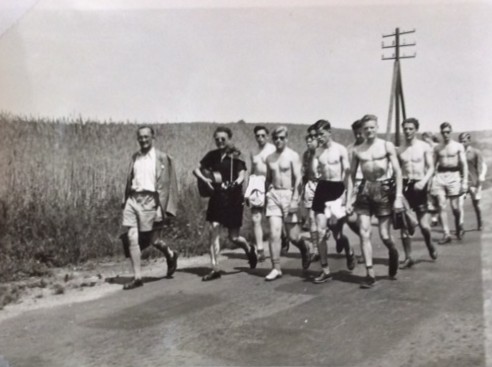
Katharina’s Story – Chapter 15: High School Years

Now that I have my bicycle I can start riding to school, the fourteen kilometers to Büdingen, during the warmer Spring and Summer months, instead of having to take the train and getting up before six in the morning. From Altenstadt, my route takes me through Lindheim, Düdelsheim, Büches then Büdingen; the beautiful, quaint villages and surrounding countryside did not suffer any air raids during the war.

There is a fairly steep hill on a tight curve before Büdingen and the first few times this hill really takes the steam out of my enthusiasm; I reach the top of the grade breathing hard with thighs aching from taking the last stretch pumping the pedals standing. But after about a week of doing this every day, my legs get stronger, and it becomes much easier. Soon I see some respectable muscles on my thighs, and I can cut several minutes off the time it takes me to get to school.  

Sunshine or rain, headwind or not, I really enjoy the ride mornings and home after school. The landscape is dotted with fields and meadows, and apple orchards line the road on one side for long stretches. There is not much car traffic in those years; sometimes I get held up, when herds of geese or pigs are driven out to the meadows right through the main street of a village, and afterwards one must weave around their droppings on the pavement. Usually, one of the village boys has the task of herding the animals out to pasture and staying with them during the day. Pigs have numbers painted on their backs, so they get back to the right farm in the evening. Geese have color markings and are herded with a rattle or a “clapper,” whereas a rod is used for keeping the pigs in line.

A “clapper” used for herding geese.

When the apples are ripe, I stop on the way home, pick up a few off the ground and eat them on the way. Fallobst, or fruit that has dropped, was not considered harvestable and the farmers usually had no objections to someone picking some up. They always were wormy and would have rotted on the ground.

Sometimes I get caught behind a honey wagon. “Honey wagon” is a  term the American soldiers have given this wagon that has a tank of sewage on it, pulled by cows – slowly, ploddingly – on the way to fertilize the pastures. Manure from the stables was stored on manure piles, the run-off collected in  a Pulloch, an underground holding tank which also served the outhouses. When being pumped out it was diluted with water and became “manure tea.’ This was what the honey wagon spreads on the pastures.

On the straight stretches of road, I learn to balance the bicycle without using the handlebars; later, I sometimes even keep notes or a schoolbook on the handlebars and refresh my lessons. Only once in all the years do I take a fall, skidding on loose gravel in a downhill turn, taking it too fast.

This is still in the time that girls do not wear pants, and shorts are not allowed at school either – at least not for girls. Most of the time my skirt is up on my thighs, except when the wind is in my back. Only riding through the villages do I try to keep it over my knees. As I get older, I get whistled at by men and I enjoy that. In Düdelsheim, at about the half-way point, my classmate Inge sometimes joins me, and we ride side-by side. She is from a family that has been evacuated from Frankfurt after the air raids destroyed a large part of Frankfurt.

At the end of the street we live on in Altenstadt there is a bike shop. The man who operates it lets me watch as he works on the bicycles. He teaches me how to true the wheels when they had gotten a little wobbly, even shows me how to replace the spokes. I take care of my bike, I learn how to patch a flat, put the chain back when it has slipped off; there is a small bag with the necessary tools and a patch kit attached to the back of the seat; an air pump on clips on the frame. My Rantzen which after a few years is replaced by a pigskin briefcase I received for Christmas, is clamped on the luggage rack over the back fender. Besides books it always holds rain gear as well.

A lot of times my briefcase also holds a swimsuit and towel for spending some time at the pool in Büdingen after school. My bike makes it easy – I don’t have to worry about missing the train. I love to swim. Once the boys’ physical education teacher taught a lifesaving course at the pool and I took part in that, a skill which I later had the opportunity to put into practice.

At some point, Mutti made me some long pants to wear during the cold months and for riding my bike to school. The principal contacted her and told her that it was unacceptable that I wore pants. My Mutti, never too shy to speak her mind, met with him and asked if he would rather have a girl freeze her legs in the winter months, giving the difficult conditions under which we had to get to school – not living in Büdingen – or in the summer months when she was riding her bike, would he rather have her exposing herself?

Mutti won the battle for the winter months, but in the summer, I wore shorts under my skirt and that solved the problem. I was happy with this too, as I could show my legs without fear of exposing anything else.

Lessons go easy, I hold my place, sharing it with a few at the top of the class. We learn English, Latin and French. There are no electives in these times, which comes later to this school. At one point the whole Podack bunch, all five of us, are in this school, and some of the teachers would lament: “Oh another Podack.”  

During the high school years,  I missed the time I had spent with my brother Hardy, who had always been my closest friend when we were small children. Now, we had grown apart, having little in common and rarely spending time together except while doing homework. He became envious of me for being among the best in our class; Papa had begun to offer small bonus payments for good grades, to encourage Hardy to keep up. While I started collecting pocket change, Hardy opted out of the program, and Papa gave it up. It disturbed me that Hardy and I were drifting apart, but as adolescents, there was little that could change the situation between us.

I was good at writing and sports. In 1951, when I am sixteen years old, I received a book as reward for placing first in a sports contest. The book was “Mein Freund Flicka” by Mary O’Hara, a book to add to my meager but precious library of two other books that I called my own. The fact that it was inscribed to me for taking first place in triathlon and celebrating the 350-year anniversary of the school itself, was all the more special.

Katharina, far left, in mid broad jump. The triathlon competition consisted of the 80-meter dash, broad jump, and high jump

I am lost in Math class, however, struggling with Calculus, and Organic Chemistry gives me fits, but I can still hold my own with a good average. I make it up in other classes, I’m beginning to recognize my strong points: languages, writing, arts, sports.

The idea of students’ rights comes to our school, I am elected for Head of Student Counsel and sent to a weekend seminar. There are many discussions among the participants, I listen and learn, though I am too self-conscious to speak. But I come away from it with fresh ideas to share, and Student Counsel petitions for no-homework Sundays. Our petition is granted, but we still attend school six days a week. We succeed in having the school library made accessible to students and set up a system that worked then and for years beyond.

Suggestions for landscaping in that bare spot in front by the street do not find a positive response, however; evidently it would involve some expenses for which there are no funds.

From the Sexta (the fifth year of schooling), we graduated to the Quinta, then would come the Quarta. After that, the Tertia was divided into two years, the Unter Tertia (lower Tertia) and Ober Tertia (upper Tertia), then came Unter Secunda and Ober Secunda and last Unter Prima and Ober Prima to graduation.

Mittlere Reife (medium maturity) was reached if one finished the Unter Tertia (the eighth year of schooling). This was the benchmark where anyone not planning to go to college would leave school, which a lot of the girls did, as well as a few boys. Hardy and I remained.

When we reached the Ober Tertia in 1950, life had become more normal. Our class made the first field trip to the Saalburg, a reconstruction of a Roman fortress, its beginnings dating back to the year 90 AD, when the Romans ruled most of Germania, inhabited by heathen barbaric tribes, if I remember any of my history lessons!

Katharina aged fifteen, with the Roman Legionär at Saalburg,
1950 class trip

After that, trips were scheduled every year. One year we explored the Marburg, where Martin Luther threw his ink pot against the wall at the devil. We stayed in a youth hostel overnight. The girls and boys had separate quarters and our homeroom teacher, Herr Knorr, had imposed a curfew. Night fell and all was quiet, but it was not totally dark outside yet. The hostel was located right at the banks of the River Lahn. I could hear the water calling to me. I snuck out undetected and started walking down the path next to the water, enjoying the sounds of crickets in the grass and the gurgling of the stream. The steps I had heard on the path came closer and when I turned to see who it was, I recognized a classmate. We walked together exchanging just a few words, until he put an arm around me. Taken by surprise I tolerated it, waiting to see what would be next.

 I had never had an eye for any of my male classmates, mainly because there had never been an opportunity to interact with them outside of school. Most were Büdingers or from some other village, so there just was no chance for anything like dating. This boy sort of startled me. But feeling a boy’s arm around me felt good. It stirred the same feelings in me that had welled up when Kurt had kissed me two years ago. But tonight, there was no kiss. I felt no attraction to this boy.

Fifty years later at a class reunion he reminded me of this meeting. I had totally forgotten it was him. I remembered the walk along the river and a boy’s arm around me but not who it had been. Last month, seventy years later I received a long e-mail from him to which I have not yet replied, but I was just as surprised about it as the night he walked up behind me by the bank of the River Lahn.

Hardy on a class trip, front row far right, wearing lederhosen. Class trips often involved a lot of walking. On this unusually hot day, the boys walked at a quick pace, trying to wear out Herr Knorr; the girls lagging behind.

Katharina (left), on a ski trip with school desk mate Mechthild. This trip was scheduled as a sports event because it was a good snow year. This was in addition to the yearly field trip.